
KINGFISHER CLEAN BLOG
What are High Temperature Coatings? How Industrial Paint Protects Your Site
An overview of what high temperature coatings are, how they work, and how they protect your assets on an industrial site. We also talk about why Health & Safety is crucial for hot painting, and how we go about ensuring safety for our team.
Published by Leonie Leeder on 7th August 2024

If your industrial site is exposed to regular excessive heat, heat resistant paint is a go-to product
Paint is generally either used to decorate surfaces or to protect them (or both). Industrial painting services here at Kingfisher usually involve protective paints that safeguard areas of our clients’ sites so that they can withstand the harsh environments they’re exposed to.
For industrial sites, paint is an ideal solution to protect and prolong the various surfaces across a factory which can be subject to chemical exposure, outdoor wear and tear, oil and grime, or, in this case, extreme heat.
Many industries rely on high temperature coatings to protect the areas on site that are subject to extremely high temperatures, which can be well in excess of 100°C. With manufacturing sites, these high temp areas are more often than not operating 24/7, and so need round-the-clock protection. High temperature painting services is a specialised service that can offer this protection, while also giving a quality visual result.
What are high temperature coatings?
Long story short, high temperature coatings are resistant to the extreme temperatures that would cause normal, commercial or household decorative paint to blister, peel, crack or discolour.
Different paints allow for different maximum operating temperatures, usually from 160°C to 750°C. They come in either liquid, powder or spray form depending on the type of surface and the application needed.

How do high temperature paints work?
Essentially, a higher top operating temperature for paint depends on the amount of inorganic material it has, like ceramic or silicon, which can both withstand higher temperatures. High temp coatings are based on silicon-oxygen (siloxane) bonds rather than carbon bonds. These form a stronger bond when cured and thus are more resistant to heat and chemical exposure, whereas more commercial paints may fade, peel, corrode or cause pitting.
Got an industrial cleaning or painting problem? We can help.
What’s the difference between heat resistant and fire retardant paint?
It’s important to say that high temperature coatings are by no means a replacement for diligent fire prevention measures and Health & Safety. There’s also a big difference between heat resistant paint and fire retardant paint:
Heat resistant paint
Heat resistant paint covers the descriptions noted above; paint that is able to withstand the excessive temperatures across industrial facilities without degrading, peeling, or losing its protective qualities.
This type of paint is great for areas such as furnaces, engines, some production machinery and exhaust systems. A lot of our hot painting work concerns gantry areas above our client’s furnace, which includes floors, walkways and handrails. The heat resistant paint that we use allows for the steelwork to maintain its integrity and protection, while also painting a visual colour-coded safety system in the client’s chosen colours.
Fire retardant paint
Fire retardant paint is a bit more specialised; it’s specifically designed to prevent and slow the spread of fire and to protect the underlying material from fire damage.
This paint is largely called intumescent paint because of its ability to swell up and char when exposed to flames. This char carbon layer then acts as a barrier to slow the spread of fire for certain amounts of time, usually 30, 60, 90 or 120 minutes.
Intumescent paint is perhaps more often found in public buildings as well as industrial sites, for example in public car parks, libraries or schools. Its not necessarily designed to withstand high temperatures for long periods of time like in a factory furnace area, but rather to protect solely in the event of a fire.
When evaluating which type of paint is the most appropriate for your facility, it’s important to think about the type of protection you need; whether its protection against heat exposure over a long period, or to help slow the spread of fire and thus aid evacuation efforts in the event of an incident.
Why is Health & Safety so important when doing hot painting work?
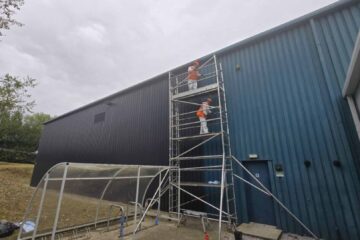
When we paint in hot areas for our clients, our top priorities are achieving a great result while ensuring the safety and wellbeing of our team. Painting in extremely hot environments can be dangerous work if not handled safely and correctly. Operatives can be at risk of dehydration or heatstroke if adequate cooldown and drinks breaks aren’t accounted for. When painting floors and metal surfaces, it’s also important to wear appropriate PPE to avoid burns when touching metal handrails or kneeling on a metal floor.
We are very proud of the diligent Health and Safety measures that we put in place. Our measures include regular cool down breaks, heat-resistant PPE, diligent training and awareness, regular monitoring and adequate hydration. This allows us to deliver our high quality ‘Kingfisher Standard’ while championing safety best practises.
Industrial Cleaning and Painting that works for you.
Get in touch for a free site consultation and project plan.
0330 043 3174
info@kingfisher-ss.co.uk
Our team here at Kingfisher have been in the industrial cleaning business for over 40 years. In that time we’ve built a reputation of being able to solve industrial cleaning problems where other companies have fallen short.
That’s because we will always source the highest quality equipment, materials and training to complete the project, often developing bespoke solutions for the trickiest of tasks.
0 Comments